Regardless, whether somebody is working as a double representative or a transaction broker, it is frequently the case that the representative will just take the complete commission offered to both sides anyhow, which leaves the purchaser and the seller in the exact same position. If you decide to work with the home seller's agent, tread very thoroughly and ask a lot of concerns.
You have an interest in it, and ask your representative to help you take a closer look, and potentially assist you make a deal. The sellers, on the other hand, have already agreed with their representative upon two things: just how much both the seller's agent and the purchaser's agent will be paid. The latter amount is generally published on the local listing service accessible by agents.
Often the total commission is split equally, and other times one side may be provided basically than the other, depending upon the parties' motivations. For example, a seller who wants to include a reward to purchasers' representatives to reveal the residential or commercial property might pay his representative 2. 8% of the list prices, but offer the buyer's agent a greater rate, at 3.
Typically, you will see percentages in the ballpark of 2. 25% to 3. 5% offered to each side. Still, this is always negotiable, and there is never ever a "basic" rate. If, continuing with the example above, you provide to buy your home for the list cost quantity of $400,000, then, the seller's representative will be paid an $11,200 commission, and your representative will be paid $12,000.
For instance, if the appraiser employed by your lending institution states that the home is worth $50,000 less than you offered for it, the seller might consent to a cost reduction (though it would be equally possible that you would be asked to come up with a greater down payment to offset the difference in what the loan provider will concur to owe you).
An Unbiased View of How Much Does A Real Estate Agent Make In Texas
In either case, the representatives associated with the deal may receive a lower commission as an outcome (taking a percentage of the final purchase rate). However, another typical situation is for home flaws to be dealt with independently. So, let's state the seller agreed to credit you $5,000 for repair work to the residential or commercial property.
The realty representative's commission is based off of the last asking price, regardless of credits, taxes, inspection expenses, and so on. Despite the fact that the commission quantity for the buyer's agent is identified by the seller, as a buyer you might still have some flexibility in the quantity your agent makes money.
This is not a common occurrence, however can and does take place as a technique of fixing specific issues. Bear in mind that a representative is under no commitment to cut his commission at closing, but it is something that you can talk about if you feel you have a strong reason for the representative to credit you.
Most house buyers and sellers work with a real estate representative, and the agent charges a commission. Just how much is the commission, and who pays it? The response in both cases is: the terms are set in the listing agreement the seller signs. Typically the buyer and the seller each have their own representative, and the commission is split down the middle in between the two agents.
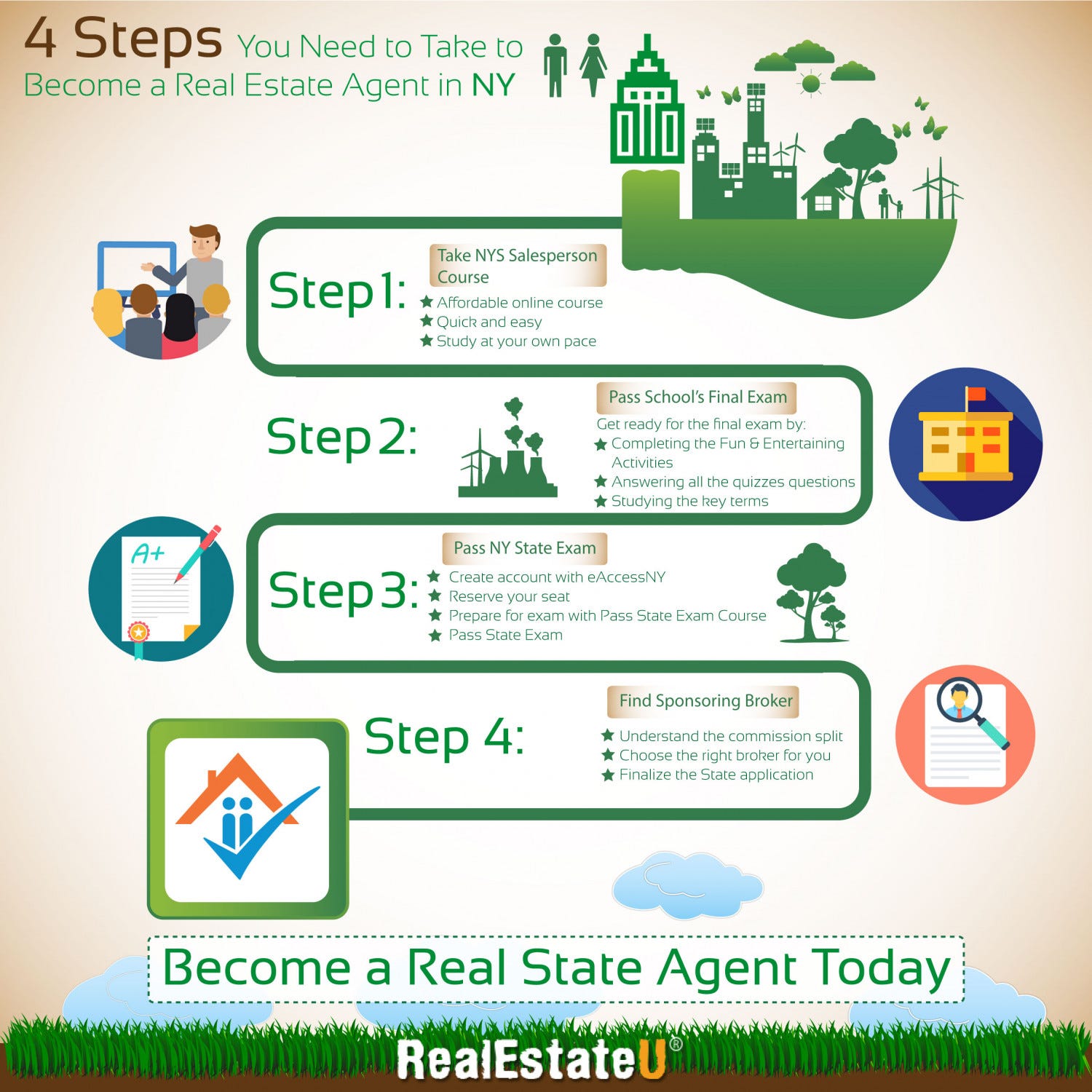

Thus, if you are a purchaser there is no factor you ought to not be dealing with a Realtor! A property representative will assist you comprehend whatever you need to understand about the home purchasing procedure and conserve you money and time. They exist to represent and negotiate for your interests and to help you find the best home, the right financing, to ensure you get the finest terms possible and that your transaction closes efficiently and on time.
The Best Strategy To Use For How To Become A Real Estate Agent In Nevada
e. commission) is a pre-arranged quantity (typically a percentage of the sales price 6-7%) that the seller has actually concurred to pay the listing agent for their service at closing and under the terms listed in the listing agreement - what does it take to be a real estate agent. The listing broker then uses part of the commission generally 3% to the agent who represents the purchaser.
Hence it is really the seller's agent that pays the buyer broker and again buyers do not pay commissions. (the very same goes for new homes/ new building and if the purchaser isn't represented by a buyers agent, the builder will not minimize the expense of the house and rather they will merely roll these additional proceeds into their marketing of their other residential or commercial properties this makes sense as genuine estate agents are the number one source of purchasers for contractors and it's not in their best interest to separate this group.) 2 essential points about commissions: The costs aren't added to the home's purchase cost.
The seller pays the commission, and the seller of a house listed with a property agent http://damienebjo545.xtgem.com/some%20known%20questions%20about%20how%20to%20start%20a%20real%20estate%20investment%20company consents to pay this commission when they sign the listing arrangement and prior to the agent marketing the house. Every agent must work for a broker; they can't act separately and are not paid directly.
Brokers set the commission they charge for homes offered through their brokerage. Traditionally, the commission is 6-7% of the sales cost, however once again, that quantity is flexible. Brokers keep a part of that fee. The representative's share, called the commission split, could be as low as 30 percent of the commission for brand-new agents or as much as 75% (or more) for veteran or highly successful agents.
During that period, the contract usually states that the seller's broker (also called the listing broker) will receive the complete commission if a contract for the sale of the home is signed, no matter the scenarios of the sale. The justification for this is that the listing agent's brokerage hangs around and cash marketing, noting the residential or commercial property, preparing your home for revealing and otherwise promoting the sale.
See This Report about How To Be A Real Estate Agent In California
Common practice is that the seller's broker shares the commission with the purchaser's broker, however it's not always an equivalent split. For example, a seller might consent to pay 7% overall commission, to be divided as 4% to the listing broker and 3% to the selling broker. There are no rules on the split.
Resident ask representative Mike of ABC Brokerage to offer their house for $200,000. They settle on a 7% commission. Steve, a buyer's representative at XYZ Brokerage, brings his clients to see your home. They agree to purchase the house for $196,000. The overall commission will be $13,720, taken out of the prices at the closing.
The brokerages have actually accepted divide the commission with 4% going to the listing agent and 3 percent to the buyer's representative, respectively $7,291 to the listing agent and $5,468 to the buyer's agent. Mike, an extremely effective representative for ABC, receives 75% of the brokerage's $7,291 commission, or $5,468 to which $2,430 is directed towards the marketing costs he sustained advertising the home.